Acting on Suggestions
Acting on Suggestions
The Clarus coach provides feedback directly within your document. Here's how to put that feedback to work.
Open a suggestion
When you see a suggestion from the coach, click the suggestion to expand it. This reveals a detailed explanation of the issue, why it matters, and the principle behind the recommendation. Clarus also highlights the matching text in the editor so you can see the suggestion in context.
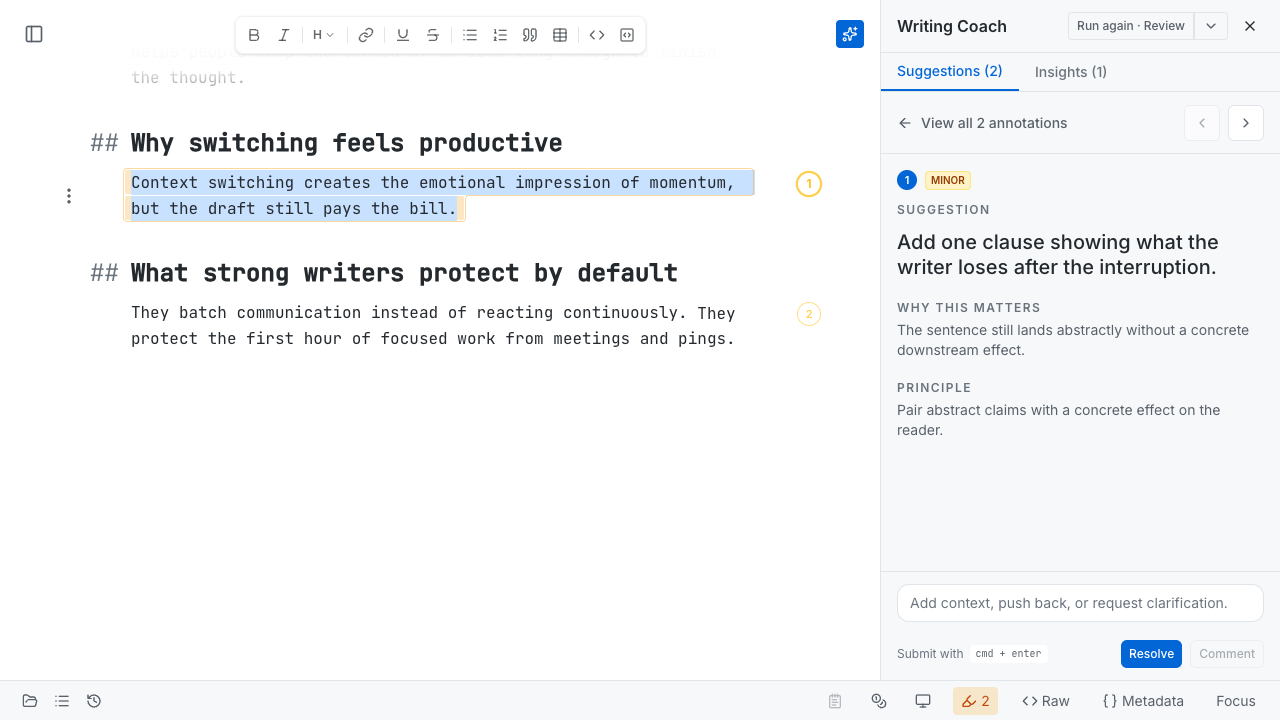
Opening a suggestion gives you the detailed explanation and keeps the draft visible beside it.
Resolve a suggestion
After you revise the draft in your own words, choose Resolve to mark the suggestion addressed. This is the best option when you’ve made the change and no longer need the reminder in your active suggestion list.
Comment instead of resolving
Sometimes, a suggestion won’t be right for your writing, or you may want to leave yourself a note before deciding what to do. In that case, type a short response and choose Comment. This keeps your reasoning attached to the suggestion without forcing an immediate resolution.
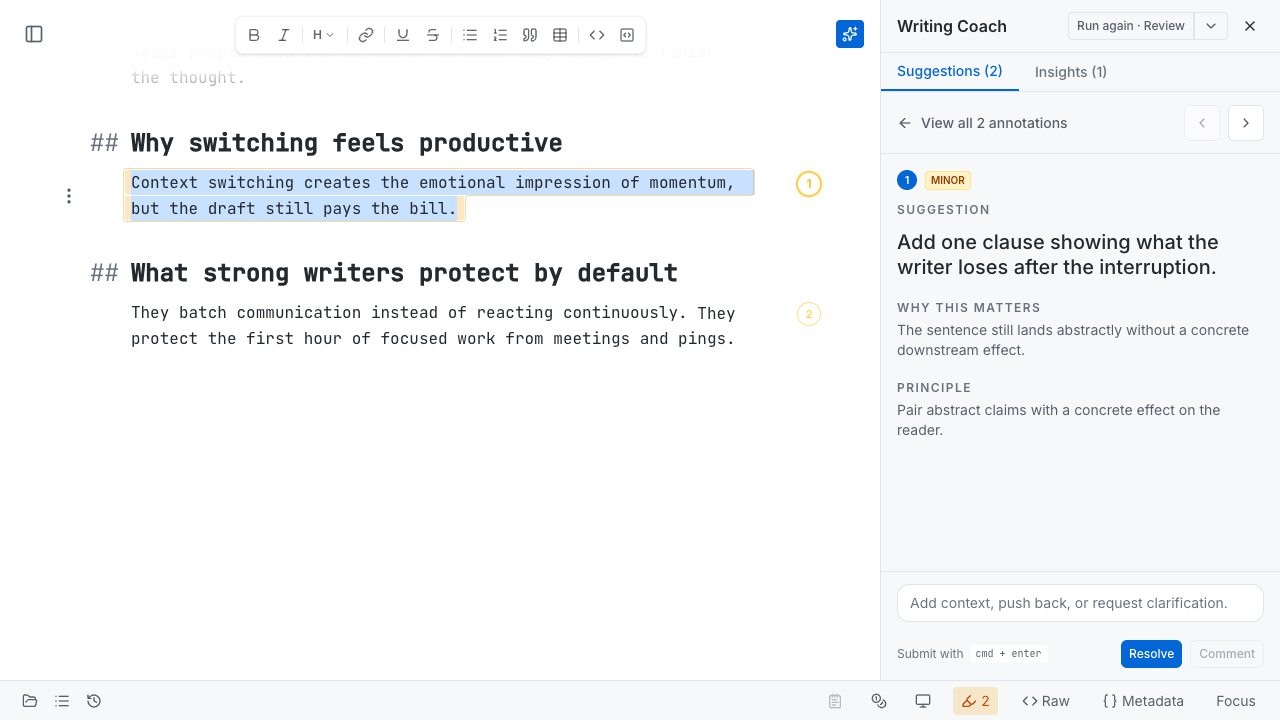
Use comments when you want to explain your choice or leave the suggestion for a later revision pass.
When to disagree with the coach
Remember that the coach analyzes your writing technically. It doesn't fully understand why you’ve written something. It assesses structure, flow, and clarity, but it doesn't automatically share your authorial goals.
If you’re deliberately using a certain style – perhaps intentional sentence fragments, unusual formatting, or a very specific tone – the coach might identify these elements as issues.
The goal of using the coach isn’t a perfect score. It’s effective communication. Trust your judgment. If a suggestion conflicts with your artistic vision or planned style, it’s fine to leave it unresolved or to add a comment explaining why you’re keeping the current phrasing.
For example, if you intentionally use very short, punchy sentences for dramatic effect, and the coach suggests you “vary sentence length,” that recommendation is probably not helpful. Feel confident ignoring those flags.
Building a revision habit
For best results, avoid checking the coach while actively drafting. Finish a section, or your entire draft, before reviewing suggestions.
The coach functions most effectively on complete pieces of writing. Analyzing fragments, sentence by sentence, limits its ability to understand the overall structure and impact of your arguments. This gives you clearer, more valuable advice.